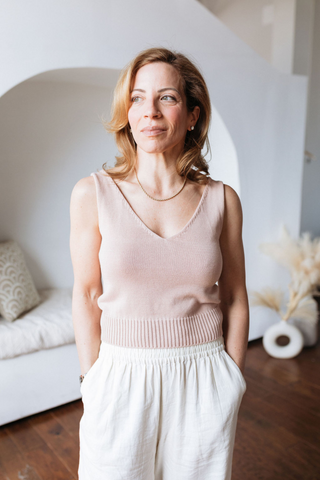

One of the things we love most about building Birdie & Claire is discovering women who are changing the conversation around what it means to be a woman in midlife. Not shrinking from it. Not rushing past it. Leaning into it, with intention and a lot of hard-earned wisdom.
Susan Campbell is one of those women.

Susan is the founder and CEO of Phosis Skincare, a clinically-tested skincare line built specifically for women navigating perimenopause and menopause. After experiencing the very skin changes her brand now addresses, she spent five years researching, conducting clinical trials, and building something she wished had existed all along. The result? A line designed to restore vibrancy to skin that's been quietly weakened by hormonal shifts, and a product that was named Oprah Daily's Best Night Cream for Menopause 2025.
Her approach feels deeply familiar to us: start with the real problem, listen to the women experiencing it, and build something thoughtful in response. That's the kind of founder energy we find endlessly inspiring.
We're so glad to share her story.
1. Take us back to the beginning. What was the moment you realized the skincare industry wasn't serving menopausal women, and how did that turn into Phosis?
I never spent much time thinking about my skin, but in my early 40s, my skin started changing. At first it was just some patchy dryness, some occasional acne on my chin, and some itchiness - mostly on my legs. Then it escalated to rashes, dullness, and my skin overall looked lacklustre.
My self confidence dropped, and I didn’t know what to do. I tried drugstore brands to manage the symptoms, and then tried luxury brands when that didn’t work. Desperate, I sought the advice of a dermatologist who recommended another drugstore brand suitable for sensitive skin. When those products failed me as well, I decided to start reading about the causes of dry skin and skin sensitivities. At the same time, I knew my hormones were showing early signs of fluctuations even though no one was talking about perimenopause back then.
As part of my research, I decided to become a certified menopause coach to fully understand the hormonal shifts, and I also went back to school for cosmetic formulation to make my own skincare products as what I was finding on the market did not help my skin.
What I learned surprised me. First, decreasing estrogen levels affect skin barrier function negatively. Second, harsh products often found in “anti- aging” skincare contribute to compromised barrier function along with the addition of added fragrances.
I searched for skincare products created specifically for peri/menopausal skin that were also fragrance free and couldn’t find what I was looking for, and that led me to start the company.
2. Five years of research and two clinical trials is no small undertaking. What was that process like for you, and what kept you going?
The process was indeed long; most brands just white label their products meaning that those products can be sold by other brands under a different name. I didn’t want to sell something that already existed, I wanted to create an entirely new line of skincare made just for women experiencing hormonal shifts. I hired the industry’s best cosmetic chemists and set to work, but it took years of research and development just to get the formulas right. I knew they had to be exceptionally clean, plant-based, fragrance-free and they had to work.
People also don’t realize that most skincare has added fragrance because the actual product smells awful. The extra time it takes to formulate with no added fragrances was not an easy feat.
Once I settled on the formulas, then came the clinical trialing. I was surprised to learn the FDA does not require skincare companies to test their products before going to market. That means that the skincare product you spend money on doesn’t have to work. I didn’t want to go to market as another brand promoting false claims; efficacy was crucial to me. Therefore I took the time to test the products with clinical trials, and then subjected them to additional testing to ensure they are dermatologically tested, ophthalmologicly tested, safe for sensitive skin via HRIPT and My Microbiome Certified.
It took years to accomplish all of this R&D and testing, but the products speak for themselves in the end. I kept going because early feedback around the products was resoundingly positive, and I knew other women in peri/menopause needed help for their changing skin too.
3. What do you wish more women knew about what's actually happening to their skin during perimenopause and menopause?
I wish more women understood that their skin is their largest organ. We are taught to protect and strengthen our hearts, our brains, our muscles and bones as we age, but no one mentions protecting or strengthening our skin.
Your skin is changing along with your hormonal levels, but that should not be seen negatively. What your skin at this time needs is support with ingredients that strengthen the skin barrier to restore and maintain hydration.
I also want women to know that what they eat, what they drink, how well they sleep, how much they exercise and how well they manage stress and anxiety all factor into skin health. Radiant skin isn’t the result of just applying one product and forgetting about it, it’s a combination of the right product with lifestyle choices that support women in perimenopause and menopause.
4. You describe menopause as "a new beginning." How did you come to see this chapter in that way, and has that perspective shaped how you built the brand?
I resent messaging in society that promotes menopause as being akin to being useless. Are women really useless because they are no longer fertile? Or because our bodies changed from a natural, biological process? I think not, and I argue that as women can live up to ⅓ of their lives in menopause, that there is no reason that this shouldn’t be the best time in their lives. We cannot stop the aging process, and it’s time to stop punishing women for the natural changes to their bodies from the menopausal transition.
For me, building this company has been very much a new beginning, as my background is in metalsmithing and jewelry design. While I’ve spent the past 25 years teaching therapeutic yoga and pilates, launching a skincare company has challenged me to grow in new ways I never expected. Those experiences have definitely contributed to the feeling of a “new beginning.”
5. Starting a business is its own kind of challenge. What has surprised you most about life as a founder?
I had no idea that I would be working all the time, including nights, weekends, holidays, vacations, and everything in between. I am never without my computer, and that means I rarely take a break from day to day operations. Scaling a new business without a background in business means there are countless things to learn along the way, and the learning curve for running a DTC company remains steep even 6 and a half years in. When you’re the founder, there is no such day as a “day off” or “vacation.” Even if you manage to take a day off, it just means there is more work to do the next day.
6. Are there any women in your life who have inspired you along the way?
I am continuously inspired by other female founders who are also bringing amazing products and services to peri/menopausal women. I am lucky enough to belong to a professional group of women all working in the “menosphere,” and these women have been a fabulous support system.
7. How has your relationship with confidence evolved over time, personally or professionally?
Almost daily, I am faced with solving a problem I don’t know the solution to. It might be an SEO issue, a supply chain issue, a website issue, or something in advertising to name a few. But, after this many years, I realize I am good at solving these problems, so that has absolutely boosted my confidence as a CEO.
Personally, I have been lifting heavy weights (15 lbs) for the past two years; I had no idea I could build such strength to be able to even lift these weights! But that strength has also boosted my confidence tremendously (and my arms look fantastic).
8. We always love to ask: is there an outfit, a go-to look, or a single piece of clothing that makes you feel amazing? Tell us about it.
My favorite piece of clothing is actually a pair of Marion Parke Classic Slingback 70 heels in patent powder. They don’t make these shoes anymore, but I feel amazing every time I step into them. Despite the fact that they are stilettos, I am known to wear them traversing through airports, and they don’t hurt my feet.
I love to pair them with the Anna Midi Dress in black from Room 502 because no matter what my day holds (a luncheon, Zooms, a speaking engagement, meetings with buyers, or a client dinner), I am ready for it!
Susan built what she couldn't find, and we find that endlessly inspiring. We're so grateful she's part of this series and even more grateful to have Phosis in our lives. P.S. We've used her products ourselves and are big fans.
You can shop Phosis Skincare and learn more about the science behind the formulas at phosis.com. Follow Susan and the brand on Instagram at @phosis.skincare.
And if you want to understand more about what's happening to your skin during perimenopause and menopause, Susan's journal at Phosis is a genuinely useful place to start.